
Reviews / 2015-04-22
Öhlins Ducati Multistrada SCU
This article was originally written in Turkish and translated with the help of artificial intelligence.
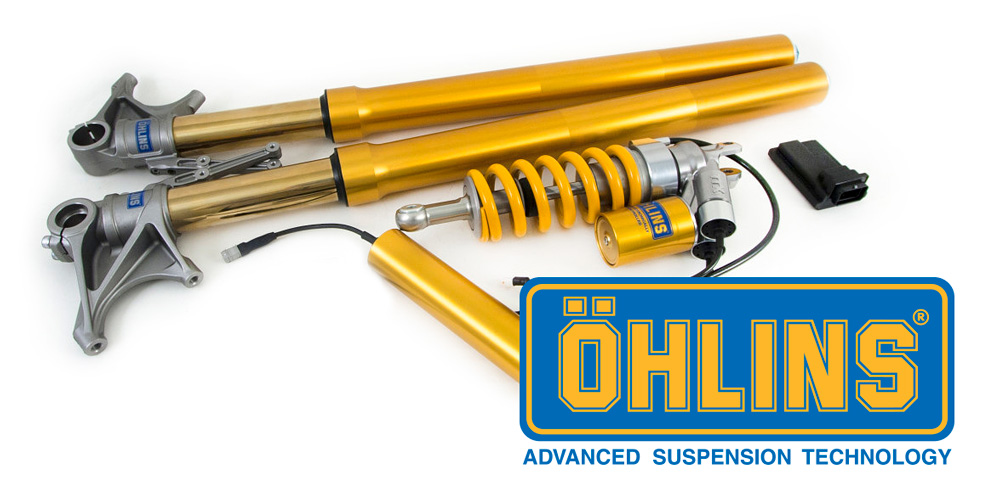
Today I am reviewing the Suspension Control Unit (SCU) that Öhlins makes for the Ducati Multistrada. This is a suspension upgrade you can fit either as the SCU alone to your existing 2010–12 Multistrada S, or as a complete kit to your base-model Multistrada. This review took me quite a while, because I had to ride the same roads over and over with different settings to understand exactly what the SCU does. I even rode around on a 2014 Multistrada S GT to work out how it differs from the Skyhook-equipped models. The things I put myself through for you! :P You really don't want tests like these to end.
 Finding the product was not easy. It is available at various prices on sites like eBay, but with electronic suspension involved, I decided not to take any chances and contacted Öhlins directly. I did, but nobody replied. I had questions to ask before buying and couldn't find anyone to answer them, so I decided to look up their Turkish distributors and came across Endo Motors in Ankara. After giving myself a telling-off, I contacted Endo Motors. As they are also an authorized Ducati service center, they answered my questions attentively and reassuringly. All that remained was to order it, and my Öhlins SCU arrived in less than a month.
A black box measuring 25 × 15 × 7 cm contains two stickers, an installation and user manual, and the suspension control unit (SCU), wrapped in protective packaging. Ducati and electronics together may set your imagination running through all sorts of scenarios, but I think this was the simplest upgrade I have ever fitted. Yes, even easier to install than an air filter. Let me explain; you can see the pictures alongside as well.
I rode to Korlas for the installation—or, more accurately, to have the existing fault records cleared and any available updates installed. First we removed the seat and connected the motorcycle to the diagnostic computer. There were no new updates, so we inspected the error messages and cleared them. I think I forgot to mention that I had received a few suspension warning messages over the previous month. After disconnecting the diagnostic equipment, we first removed the plastic side panel on the left of the bike. I think there are four screws in total, but you need two different Allen keys. <3 Ducati. Right underneath, you can see the old SCU beneath a rubber cover.
At this stage, first disconnect the battery's negative terminal and secure it so that it cannot touch anything. Then carefully unplug the old SCU's connector. Dirt may have made it stick, since it has not been touched for a long time; take care not to break its locking tabs. Once the connector is off, remove the old SCU from its rubber sleeve. It is a delicate electronic component, so remember to handle it gently.
Take the new SCU out of its packaging (I put the old one in the package), clean the area around the rubber sleeve, and fit it in place. Before plugging in the connector, inspect the pins and its red seal, cleaning them if necessary. Listen for the locking tabs clicking into place as you attach it. Check all the connections, then reconnect the battery terminal. When you switch on the ignition, you will hear the servos. The suspension servos will run their self-test and move to their starting positions.
You can now refit the plastic panel you removed, followed by the seats. That is the mechanical installation done; I think it took 10–15 minutes. In reality, though, the installation is not finished yet. For a start, setting the clock probably costs me another ten minutes. DTC will have switched itself off; you can activate it from the main menu. Then, to enable semi-active suspension for your chosen riding mode and load setting, you need to enter "1" for both compression and rebound damping, front and rear. With four riding modes and four load settings for each, that means repeating this process 16 times if you want your MTS to behave semi-actively in every situation. :)
Now for the review. Although there is something I want to say straight away: If you own a 2010–12 Multistrada S and have never touched any suspension adjustment other than spring preload, stop reading, contact Endo Motors directly, and order one right now . The product is called the Öhlins SCU, its part number is 35000-03, and it costs €415 including VAT. In fact, if you weigh 90 kg or more, I would also recommend buying a rear shock spring suited to your weight; that costs €160.
Let me first explain in simple terms what this product is. I can already feel myself getting lost in the details later in the article. :) As you know, Ducati Multistrada S models have Öhlins electronic suspension. All adjustments are made through the instrument panel and control buttons. As standard, there are four main preset modes. In each one, both the engine and suspension behave differently. The Öhlins SCU adds semi-active capability to the motorcycle. It also lets you adjust the front suspension in increments twice as fine, with 32 levels instead of 16. With this control unit, the suspension changes its settings to suit the situation without any input from you, but it cannot keep the motorcycle constantly parallel to the road; that is why it is described as semi-active.
On my first ride, in Urban mode, it felt firmer. At the same time, it was still supple over potholes and bumps. Yes, that is what semi-active means, but it shouldn't be able to do this, because it has no information available about the road surface. Some of the sensors on the Skyhook-equipped models are absent from the early bikes. So how on earth does it do it?
I rode some more, switching between the old and new settings. This was driving me mad: there was noticeably less dive under braking, and the front wheel was harder to lift. The difference was particularly obvious in Urban and Touring modes. I used up a tank of fuel, still puzzled. Honestly, I couldn't work it out...
That evening I sat at my computer at home, reading and reading. Öhlins had not written anywhere what the SCU actually does, and rumors were everywhere. Then there were the facts: the information it can access on the Multistrada is limited. As I read, I wondered whether it might be a placebo effect. I decided to film it the next day and went to sleep.
Following a tip from Barkın, I picked a corner with a rough surface that also required some lean angle. With the camera recording from outside, I rode through it first one way, then the other—with each set of settings. This time I checked the speedometer too, and there was a difference! I went home happy. Knowing it wasn't a placebo cheered me right up. Watching the footage, which unfortunately I cannot share with you, you can make out some of the difference. In particular, you can see that the bike pitches less on entry and exit. Only one question remained: how does it do all this? Yes, the suspension has servos, but changing a setting is one thing; adjusting it continuously is another. A servo gets hot; it can burn out.
After some training sessions intervened, I kept thinking about it. I actually found the answer to my last question between the lines. When Ducati partnered with Öhlins, active suspension was already part of the projected development. I spotted this in the sketch stages shown in the Multistrada's pre-launch promotional video. With that in mind, I suspect the servos used were designed for continuous movement right from the start. After all, Öhlins had developed a similar system in SBK before the Multistrada.
Let's look at the available data. Through the motorcycle's potentiometers, the SCU can access information such as acceleration, deceleration, wheel speed, throttle position, wheelspin, and engine power. From my riding experience, the power setting I select—100, 150 Low, or 150 High—changes the SCU's behavior. I suspect even the way I use the throttle has an effect within the same setting. I think Öhlins has devised a series of predictive algorithms. After all, they have all sorts of motorcycles to work with, starting with the Multistrada for which they develop products. Since it cannot measure what is happening the way Skyhook does, and responds a little more slowly, it changes the settings by anticipating things, so to speak. This isn't something I know for certain; I am making a reasonably plausible educated guess from what I do know. Don't tell anyone. :P
To sum up, Öhlins has loaded this SCU with a series of algorithms, allowing it to keep making adjustments by predicting the kind of road surface you will encounter. It is as though you have a suspension technician riding behind you. The end result is that you get to experience an already good suspension system working even better. A wonderful experience. :)
Before I forget, don't neglect to set your motorcycle's sag using spring preload. If you reach the limit of the preload adjustment while doing so, take that as a sign that you need a stiffer spring. Please don't just ride your Multistrada exactly as it left the factory; remember to set the spring preload. Add this Öhlins SCU on top, and you will really feel that you are riding a motorcycle with properly set-up suspension. :)

If you want a quick comparison after installing it, choose, say, the rider-only load setting and enter 1 for C and R at both the front and rear; leave the rider-plus-luggage setting at the factory values. That way, you can quickly switch between semi-active and normal suspension settings while riding.
Don't expect Skyhook, though. Rather than predicting things, Skyhook measures what is actually happening and changes the settings very quickly. For me, this upgrade has been enough to skip the intervening model. The new DVT Multistrada still interests me, though; if only I could get a ride on one...
My thanks to Endo Motors for helping me get this product, and to Korlas for installing it. If you have a 2010–12 Multistrada, the best upgrade you can buy for your bike is waiting for you. You can even give your base-model Multistrada semi-active suspension by buying the complete kit shown in the opening picture. Enjoy your rides.