
Reviews / 2011-12-16
Ducati Multistrada 1200S
This article was originally written in Turkish and translated with the help of artificial intelligence.
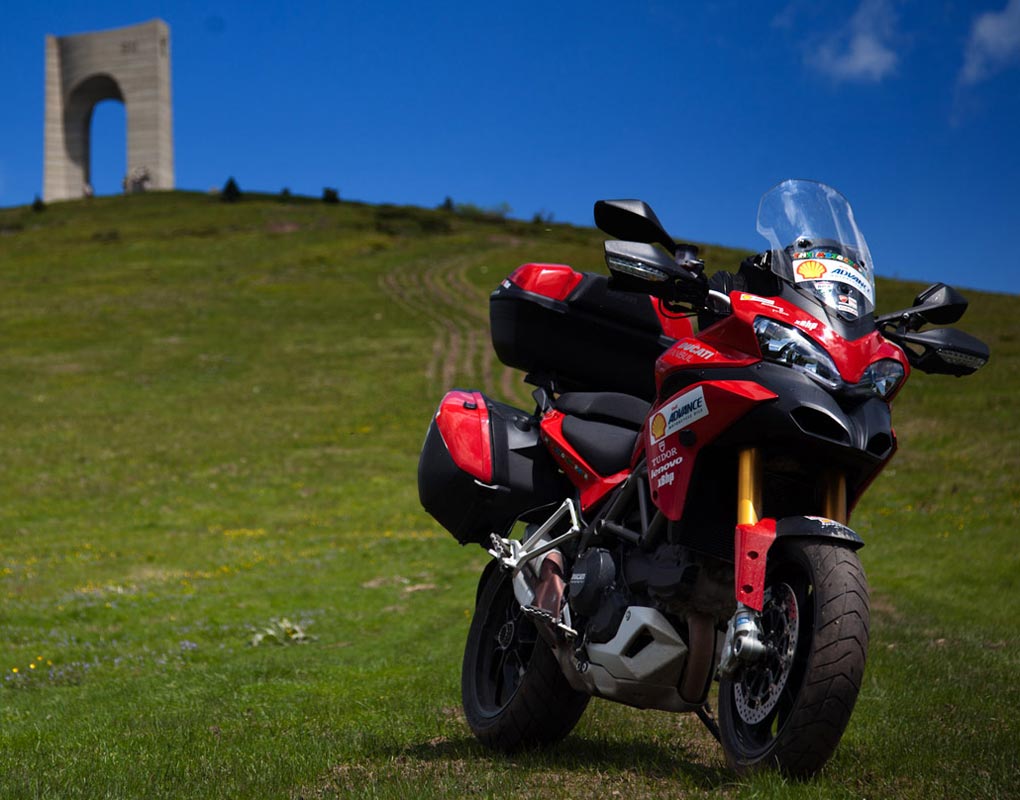
Multistrada translates as “many roads”; the first product of Ducati's idea of creating a model that could be ridden beyond the asphalt appeared in 2003. The first MTS I experienced was also a 1000DS. On one of my early road training sessions, Yiğit, who was then bringing up the rear as the safety rider, was curious about my GSR, and I found myself on the MTS. It was a frightening experience. Its power, out of all proportion to my inexperience, and its harsh responses had fear running through every cell of my body. The rattling from its exposed clutch made me think something was breaking; I had not understood the machine.
- 2005 Ducati Multistrada 620 ----- 2003 Ducati Multistrada 1000DS --- 2007 Ducati Multistrada 1100DS -


I will skim through this, since it is not our main subject, but I wanted to include the model's development, so I will touch on it briefly. The 1000DS appeared in 2003, with an air-cooled, twin-spark V-twin, Showa suspension, Brembo brakes and a trellis frame. In 2005 the smaller-engined 620 arrived alongside the 1000DS S. The “S” version featured Öhlins suspension and carbon-fibre parts. In 2007 the 620 was discontinued and the 1100DS launched. This time the “S” used Marzocchi at the front and Sachs at the rear, while a wet clutch became standard equipment on the MTS. Production continued until 2010, which is actually the year that interests us, because in 2010 a 1200 version went on sale and landed like a bombshell on the world.
At this point, it is worth remembering that Ducati's last world-stunning model had been the 916 in 1994. In 2010 no other brand offered the technologies it already had. It was wonderful that, after the MTS bombshell, BMW printed its 2010 updates in tiny type: a 5% power increase to 110 HP, maximum revs raised from 8,000 to 8,500, two radial OHCs, an electronic exhaust valve for a wonderful sound, and colour options with fancy names. icon_twisted.gif.bak
Even I, a naked-bike rider, was impressed enough to go and examine it. To put it simply, at the heart of it lies the Testastretta 11° engine (11, not 2). It is a version of the 1198 SBK engine with valve overlap reduced from 41° to 11°, producing around 150 HP and able to rev to 11,000 rpm. It was basically offered in four versions; SS and ST differ only by a few carbon parts. The base model uses 50 mm Marzocchi front suspension and Sachs at the rear; the “S” versions use 48 mm Öhlins at the front and Öhlins TTX at the rear, with all their settings electronically adjustable. On the “S” models ABS, two panniers (three cases on the ST) and a centre stand are standard. The version named after the race it has won since its launch sheds the extra weight and comes with carbon-fibre parts and a Termignoni exhaust system: Pikes Peak.
2010 - 2012 Ducati Multistrada 1200 - Ducati Multistrada 1200 S/T - Ducati Multistrada 1200 Pikes Peak
bnj2.jpg
s2s7.jpg
lsrx.jpg


After all that background, let's return to our subject. Contrary to what people think, I have actually had two MTSs. I passed the first to a friend while I was in the process of registering it in my name. The second was actually the bike used for Mission Red Planet ; I took it over from Italy through Korlas. The bike is more famous than I am, since it also appears, number plate and all, in Ducati's worldwide 2013 and 2014 catalogues.
I want to return to my first day riding it. After climbing aboard, I played with the settings a little. As you know, there are four riding modes, which change the available power, throttle sensitivity, suspension, traction control and brake settings. To keep it from flipping over on top of me, I ride in the gentle Urban setting: 100 HP, DTC 6, ABS 2. Getting used to the cases takes a while; blimey, I say, this is wide. From the Cadde to Çekmeköy I ride gently, fiddling as I go. I am not too sure about my purchase.
I remove the cases and thoroughly read the handbook at home. I even read a few articles online and give it a full check and adjustment before heading out again. Now I will ride in Sport mode. icon_twisted.gif.bak Let me give my first warning here: changing the mode changes throttle sensitivity noticeably. If, like me, you switch from Urban to Sport and open the throttle as you did in Urban, fear arrives along with a front wheel lifting off the ground. You quickly wise up and recalibrate your wrist too.
I head towards Şile. When I give a firm countersteering input for a quick lane change, the bike leans so sharply that I think I have fallen off. I suppose this is what being high up feels like, I tell myself, trying to adjust. Steering is extremely simple. A naked-bike rider might say it turns itself; you only have to look. I stop at Ela and think over the things spoiling my enjoyment.
I do not much like the height: leaning feels different, and the fork just keeps diving. I am constantly tending to lift the rear wheel. Nor can I open the throttle; it wants to flip over me. Should I buy the Monster Evo instead? It looked so forlorn back at Korlas. This one sounds awful too, like a tractor. I do not give up; I go back to the bike and adjust it again. Preload to suit my weight, two clicks firmer to stop the front compressing... Hang on, I have not even set the sag! Back to square one. With a friend's help, this time we take our time setting it up and head out again.
Now I can brake the way I want. It seems time to open the throttle a little. icon_twisted.gif.bak Ooh! This thing is fast! You hear people saying it is fast, comparing it to the GS and so on. It is not like that: this is not a relatively quick tractor; it is superbike fast! My friend says, “Mate, the gap never closes anywhere. I cannot catch you on the straights either; this thing is fast everywhere.” The other bike in question is an 848! Let me be quiet for a moment while you watch the video below. Safety, equipment and so on are sorely lacking, but I think it makes what I mean easier to understand.
The display is in miles, by the way. These are actions we do not approve of.
After the first day, I became thoroughly used to the bike. Now, with 20,000 km behind me, my impressions are clearer. The first thing I would say is that the MTS is not an enduro; in my opinion, neither are the GS and similar machines. The EXC 450, DRZ 400, perhaps the KTM 990: those are enduros. If you have the money and are prepared to fit suitable tyres, the MTS will easily cross any terrain its rivals do. You can stand up or stick a leg out. It is already lighter than all its rivals. Perhaps one or two models have larger front wheels, so off road you may need to be more careful than on those, especially in ruts.
What I mean is that this is a comfortable, powerful touring motorcycle with a sporting soul. It is not a product you can ride before learning to ride a motorcycle. It does whatever you command, right or wrong. Let me say from the outset that riders whose reserves of experience are below a certain level will be happier on something like a GS.
The second thing I want to mention is the brakes. They are very powerful. The Brembos do their job extremely well. Bosch's ABS intervenes at the right time; it hardly interfered even when I was testing it. But the bike is tall, and squeezing before allowing weight transfer can lift the rear wheel off the ground. Achieving 100% weight transfer is very easy on this bike. Give yourself time to get used to its brakes and to the suspension's responses in different settings. Perhaps the 2013 model with Skyhook, or the additional control unit made by Öhlins , would suit you better.
A few points I skipped deserve mentioning here. First, on models with semi-active suspension, unless you use Sport or Enduro mode, the system does not allow the rear wheel to lift. The other point applies to most motorcycles. It results from 100% weight transfer, a natural consequence of good grip and powerful brakes. This dynamic applies from the Duke 200s we use in training to the CBR 1000RR; it is not peculiar to the MTS. The MTS is a fairly tall motorcycle with 170 mm of suspension travel, 25° rake, 109 mm trail and a 1,530 mm wheelbase. When the brakes are applied that quickly and hard, one of two things will happen: either the front tyre slides or the rear lifts off the ground. How to brake is a subject for proper machine-control training.
If you are not used to riding in the correct rev range, the MTS will shake you about and express its displeasure. It is not a CBF 1000-style “stick it in sixth and relax” machine. Fat Duc or the twin-spark ignition on the newer model may change that behaviour, but the MTS's heart was designed for a different sort of riding. In town and traffic, it is wide with the cases fitted. Even without panniers it is wider than the CBFs. Without cases it is 945 mm wide, compared with 780 mm for the CBF1000, 953 mm for the BMW R1200GS and 990 mm for the Adventure. It is very manoeuvrable, and tight turns are quite easy. Although I do not like riding in traffic, it is an easy bike in town for its size.
I consulted my two pillions about riding as a passenger. One said magnificent and wonderful; the other chose comfortable and relaxing. There is a backrest for the pillion on the front of the top box. The footrests are well spaced and the seat comfortable. A pillion hardly affects the MTS; it has enough power. icon_twisted.gif.bak But if you do not select the appropriate setting with a couple of clicks when taking a pillion, your front wheel can easily leave the road. It pays to adjust it and keep your wrist in check. I do not remember feeling any helmet buffeting with a passenger. Loaded up, it accelerates almost as it does when I am alone. As I said, you need have no worries about acceleration on this bike. In a word, it is excellent for riding two-up too.
Although I have not yet made a long journey, I can say its luggage capacity is adequate. The top box takes two full-face helmets. The panniers have been revised, with extra catches added at the front and rear of the newer ones; the old ones can let water in. With the top box fitted, at high speed around 180 km/h the front begins to move very slightly. Those planning to ignore the warning labels inside the cases should bear that in mind. Going faster, it increases a little and then disappears again.
kelebeky.jpg I have had four problems in total. First, the clutch did not fully disengage because the plate surfaces had begun to deteriorate from excessive heat. It was not a big problem and did not much affect riding, but I became suspicious and replaced it. Perhaps the person who rode it round the world used a lot of clutch, or perhaps I did it while demonstrating slow riding; I do not know. Another issue was that the valve at the exhaust outlet stuck because of dirt; removing and cleaning it fixed that. The most serious problem was the rear cylinder head, which I think had a crack allowing coolant into the combustion chamber. The whole thing was replaced free under warranty. :) Finally, the left fork leg began leaking oil, so its seals and oil were replaced.

When Ducati comes up, warranty matters tend to make people uneasy. My experience may interest you. To my mind, the most important point is that when your bike arrives for service and is connected to the computer, work cannot continue without the software updates being installed. If there is a recall concerning your bike—a factory part replacement specifically for your chassis number—the necessary parts even arrive before you take it in. My ignition lock set, with which I had actually had no problem, was replaced free through this procedure too. At 24,000 km I had what we could call the major service, including valve adjustment and belts. At 27,000 km I replaced the chain with a DiD 530 ZVM-X. During that same service I renewed the hydraulic fluids too.
On forums you may read of some owners having gearshift problems. I have not had them, though I managed to reproduce one deliberately. If you make a half-hearted or gentle movement instead of fully engaging the gear, you can leave it between gears. Why you would do that, I do not know. The gearbox is firm and its shifts very audible. I have had no problems in use.

The original Pirelli Scorpion Trail tyres lasted 18,000 km. I replaced them with the more road-oriented Michelin Pilot Road 3. I had actually intended to buy Metzeler M5s, but could not find a 190/55/17. So far I am happy, though I think they will last 10,000 km. As I said, the bike is fast and it corners too; the tyres pay the price. The thing is fun to ride, and these days I even like its sound, though the Monster's sound was something else...
As a naked-bike rider, I found its headlights adequate. Likewise, I keep the screen somewhere low down. At high speed I have wondered whether a slightly wider one would be better; perhaps that matters to you. Getting caught on a cold day in thin gloves gave me a chance to try the heated grips. Even the first level felt too much for me, and there are three. Probably because I am not used to them, or perhaps they intended people to ride the bike in Alaska or somewhere?
I nearly forgot. During my first days on the MTS I could not get comfortable with my left foot. It landed on the centre stand's extension and I kept pressing it unintentionally. I got used to it, but remember complaining initially. My right foot is not very comfortable either; I usually rest it against the exhaust shield. Fine in winter, a bit too hot in summer. You have to get used to that too, or go straight to a Termignoni; another 12 HP would not hurt. The exhaust is sold as a kit that includes an additional ECU module. This also adds a racing option to the settings menu. icon_twisted.gif.bak
In general, it is not a particularly economical motorcycle. I usually ride in Sport settings. You can see the current figures below:
161824.png
There is constantly around 130 kg of load on the bike, the top box is always fitted, and most riding is in town or during training; bear that in mind when judging it.
Accessing settings other than the riding modes and load settings is a little laborious. Anyone unfamiliar with the subject may become confused. Fortunately there is an option to restore the factory settings. Do not hesitate to choose tyre pressures (between 2.5 and 2.9 bar) and suspension settings to suit your weight. When you first buy the bike, remember to change the security code that lets you start it without the key. You can carry the key in the compartment on the right at the front; I usually keep it in my pocket so I can open the case.
At the end of the day, we are talking about a motorcycle that puts a smile on my face every time I ride it. If things go well, my next bike will be an MTS too. It is late now; tomorrow I will read this through and try to fill in anything missing.
Stay well.
i2y1.jpg
Edit: I corrected some typos and tried to include answers to some of the questions asked. I also updated it to cover the latest service information.